Cointelegraph reported on November 11, 2026 that a consortium of 21 financial institutions had committed about $270 million to Project Faro, a bank-backed initiative meant to act as a stablecoin issuer. The project aims to launch a US dollar stablecoin in the first half of 2027.
According to Bloomberg, as cited in that report, the funding is intended to cover five years of operations for the new company. The company plans to issue stablecoins pegged to the currencies of all G7 countries, with a euro-backed coin expected to follow the dollar launch.
What was confirmed, and what was not
The group first announced the initiative in September. Confirmed details were thin. People familiar with the matter said the company was expected to be incorporated in the United States, Bloomberg reported.
Participants include banks such as Citigroup, Goldman Sachs, Banco Santander, Deutsche Bank and BBVA. The November 11 report did not describe reserve assets, any attestation or audit, redemption terms, or whether a future token would be insured or continuously redeemable. A planned peg and a funding commitment for operations are not the same as evidence of backing.
The same banks in more than one project
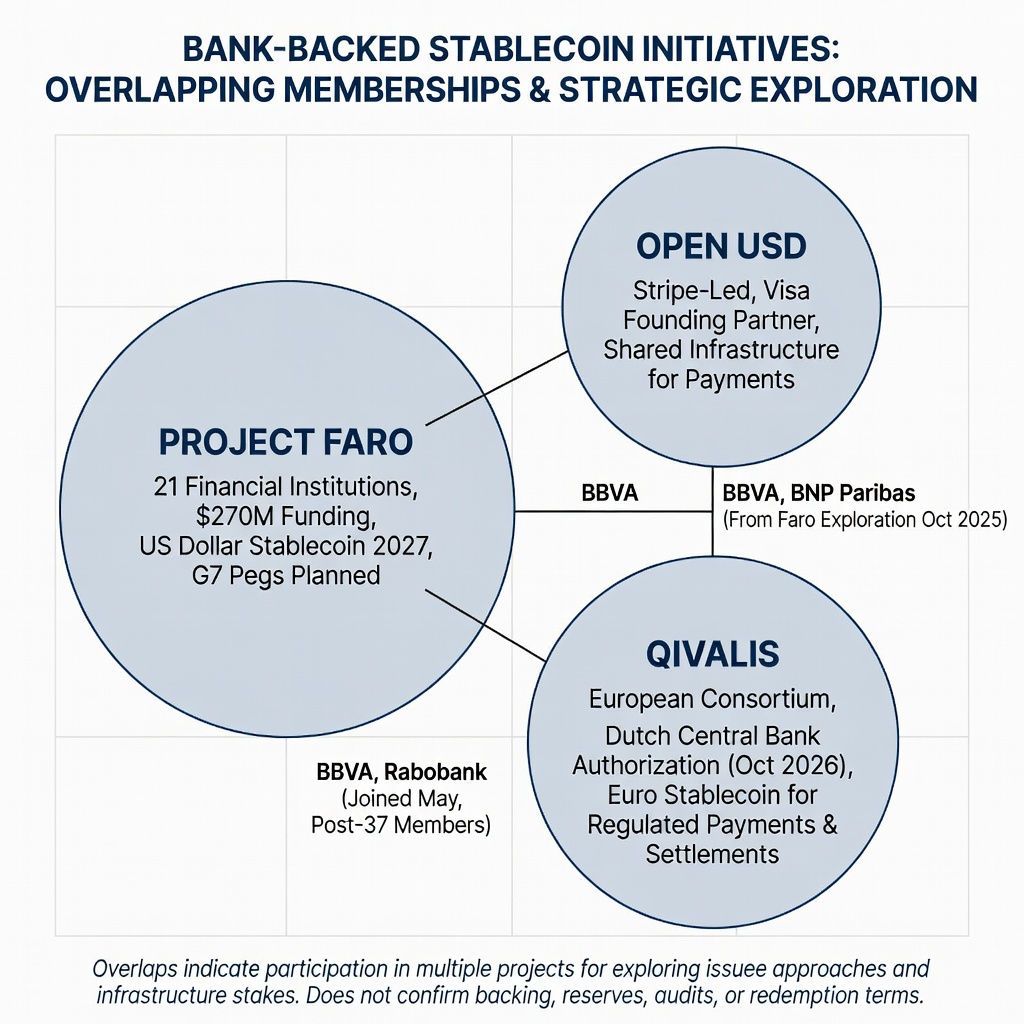
Comparable efforts were also underway. Stripe-led Open USD counts Visa among its founding partners. Qivalis is a European banking consortium seeking to challenge the dominance of US dollar-pegged stablecoins.
Membership overlaps. BBVA is a Faro member and is also involved in Open USD and Qivalis. Dutch lender Rabobank is a Faro member and joined Qivalis in May, when that euro consortium added 25 banks to reach 37 members. BNP Paribas was among the 10 banks that first explored what became Faro in October 2025 and later joined Qivalis.
Qivalis received authorization from the Dutch central bank as an electronic money institution in October 2026. It was preparing to launch a fully regulated, euro-denominated stablecoin for payments, cross-border settlements and tokenized asset transactions.
The overlaps show institutions taking positions across more than one issuance project rather than committing exclusively to a single effort. Participation lets banks explore different approaches to issuing and distributing digital currencies while keeping a stake in infrastructure that could support payment and settlement. Those strategic facts do not establish how any coin would be backed or redeemed.
Circulation already in the market
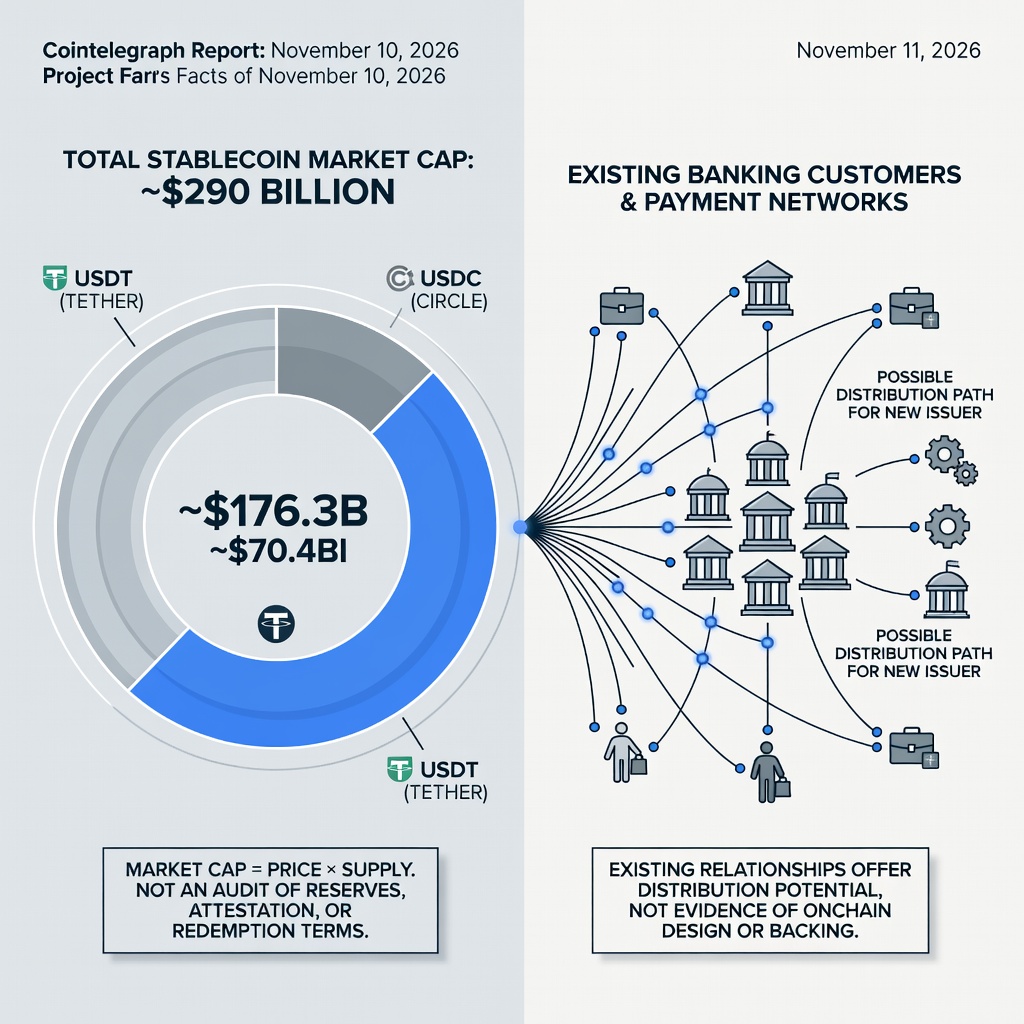
As of November 10, Tether’s USDT and Circle’s USDC accounted for approximately 85% of the roughly $290 billion stablecoin market, according to DefiLlama. USDT’s market capitalization was approximately $176.3 billion and USDC’s was around $70.4 billion. Market capitalization is a price-times-supply figure; it is not an audit of reserves and does not describe redemption terms.
The report said distribution could be an advantage for the bank-backed venture because the institutions already have banking customers, payment networks and relationships with businesses and financial institutions, including a path toward retail users. That is a distribution possibility, not a statement of onchain settlement design or issuer obligations. Open USD, from the Open Standard consortium, was described as gathering payment providers, banks, financial technology companies and merchants around shared stablecoin infrastructure. For both, the identified challenge was turning existing financial relationships into a competitive onchain payment network.
Source: cointelegraph.com (originally published 2026-11-11 07:08 UTC+8)