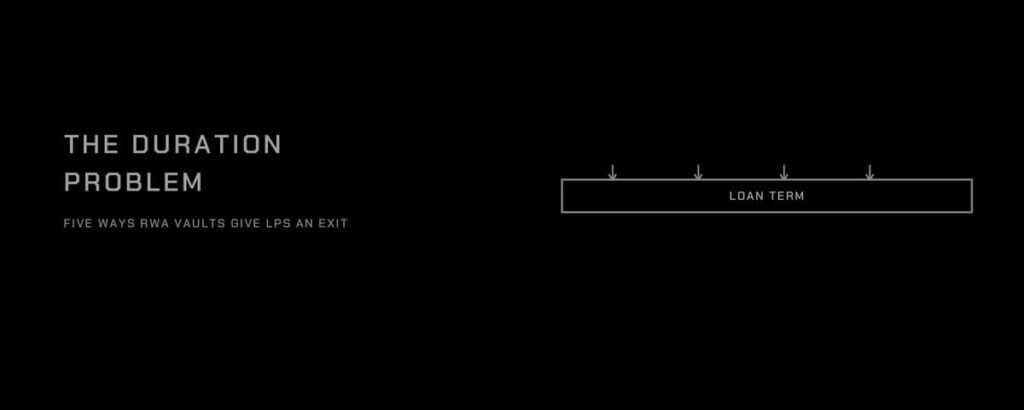
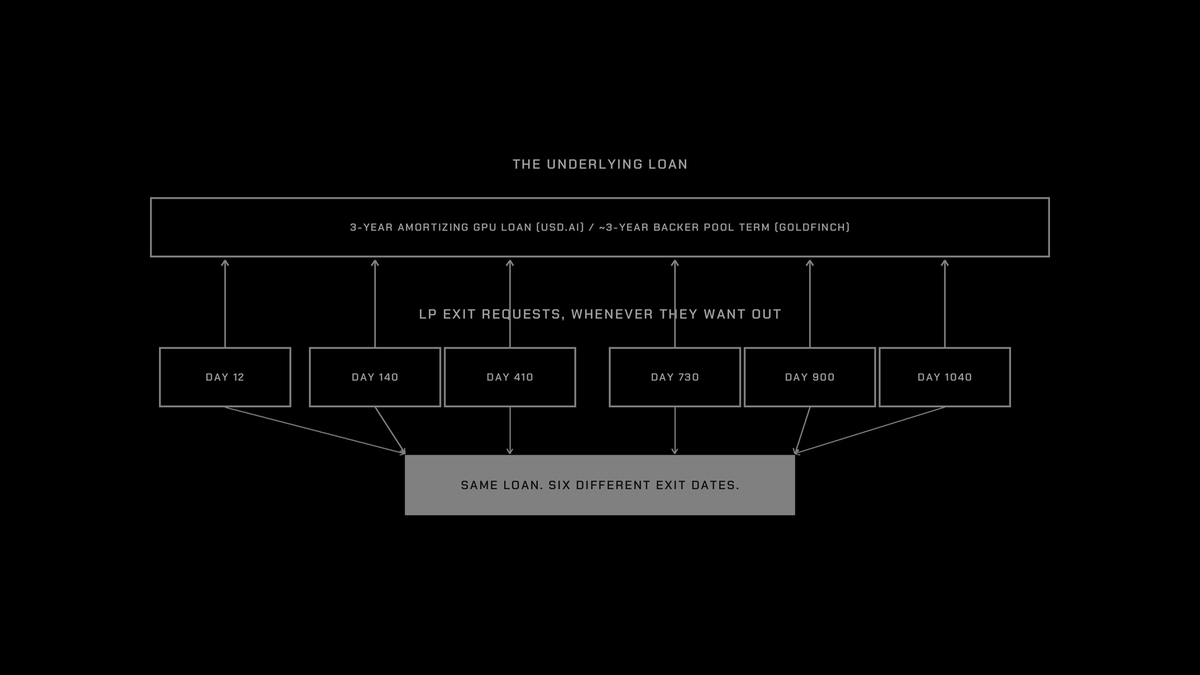
USD.AI’s GPU-backed loans amortize over three years, with borrowers paying principal and interest every 30 days. A depositor can ask to withdraw between payments, but the request does not make the borrower’s next installment due any sooner. Either the vault has cash, someone else buys the position, or the depositor waits.
In an analysis published on November 27, 2026, at 20:54:26 UTC+08:00, nikos examined five ways real-world asset (RWA) protocols handle that mismatch. The key distinction is between liquidity risk—having to wait or sell at a discount—and credit risk—the possibility that the borrower does not repay. An early exit can transfer either risk to someone else; it cannot make the loan pay out in full.
1. Cash buffers: who gets paid when cash runs short?
USD.AI caps new lending at 90% of total sUSDai capital, leaving at least 10% outside the loan book. It processes redemption requests in 30-day cycles on a first-in, first-out basis. If a large request is first in line, it can absorb all the available cash before later requests receive anything.
Goldfinch’s Senior Pool uses a different rule. It processes withdrawals every two weeks and, if there is not enough USDC, divides the available balance pro rata among requesting liquidity providers (LPs). Each receives the same proportion of the amount requested rather than waiting for an earlier request to be filled in full. Centrifuge’s earlier Tinlake pools used processing periods of at least 24 hours and gave redemptions priority over new loans.
A processing window is not a promise of full payment on that date. Once requests exceed the buffer, further withdrawals depend on loan repayments or new inflows.
2. Tranches: a senior claim gets priority, not cash on demand
Goldfinch’s Backer Pools historically had an average loan term of three years. Its senior token, FIDU, gave holders exposure across multiple pools. Under the original design, holders could redeem against idle Senior Pool capital. Junior investors in a particular pool remained exposed until its loans were repaid or written off. They took the first losses, typically in exchange for a higher yield.
Tinlake likewise gave senior DROP tokens redemption priority over junior TIN tokens. In both designs, seniority determines who has the first claim when cash arrives. It does not accelerate the borrower’s payments.
3. Secondary markets: the buyer sets the exit price
A holder of Maple Finance’s syrupUSDC or syrupUSDT can sell on a decentralized exchange such as Uniswap instead of joining Maple’s first-in, first-out withdrawal queue. The seller receives the market price, less fees, and a large trade can move that price. Goldfinch’s community also maintained a FIDU/USDC pool on Curve without the protocol itself supplying market-making liquidity.
Total value locked (TVL) does not measure how much a holder can sell. A vault could have $100 million in TVL yet have little trading depth. For an early exit, the relevant figure is the amount buyers will take at a given discount to net asset value (NAV).
4. Transferable claims: selling a place in the queue
Centrifuge’s proposed ERC-8161 standard would extend the ERC-7540 asynchronous vault model by making pending deposit and redemption requests transferable. Instead of buying a vault token and submitting a new redemption request, a buyer could acquire an existing request with its queue position intact.
For a vault with a redemption window measured in weeks or months, a seller willing to accept a discount could receive cash before settlement. The buyer would take on the remaining wait; the vault would not have to change its schedule.
5. Discounted purchases: a liquidity vault waits for the issuer
Symbiotic’s Liquid Lane lets an RWA holder submit an on-chain request for quote (RFQ). A participating vault can buy the asset subject to contract-enforced limits. For its USDC RWA liquidity vault, KPK published a minimum purchase discount of 0.05% for Centrifuge’s JTRSY and JAAA and discounts of 0.80% to 3.00% for certain Midas and Pareto assets.
Two conditions constrain a purchase: its expected return must exceed what the same capital could earn on Morpho, and at least 50% of the vault’s capital must remain immediately liquid afterward. The purchased asset goes into a designated redemption account. The seller has USDC; the vault holds the claim on the issuer.
The reported settlement periods varied by asset: some Centrifuge assets had no cooldown, certain Midas assets typically took 12–36 hours, and some wrapped Pareto assets could take 32–63 days. The discount compensates the vault for waiting and bearing the risk of a shortfall. Redemption at the expected NAV is not assured. If the discount is insufficient or the issuer pays less than expected, the vault’s LPs bear the loss, with no external insurance fund to cover it.
When the borrower stops paying
Goldfinch originated about $100 million in loans before some became seriously delinquent. The protocol reported recovery timelines of more than two years. Final write-downs for some pools were estimated at 80% to 100%; those estimates were not confirmed losses across the entire loan book.
Goldfinch had withdrawal rules, junior capital and a secondary market. Each could affect which holder received cash first or at what price a holder could leave. None could determine how much a distressed borrower would ultimately repay. That is why a vault’s quoted withdrawal window tells only part of the story: the amount of cash available, who supplies it, and the rule for allocating it when several large holders request it at once matter just as much.