
Reported 24 November 2026. Clapp Finance has launched the Clapp Crypto Card, a Visa card that, the company said, pays a merchant by drawing on the holder’s USDT or USDC balance and converting the stablecoin at the point of sale.
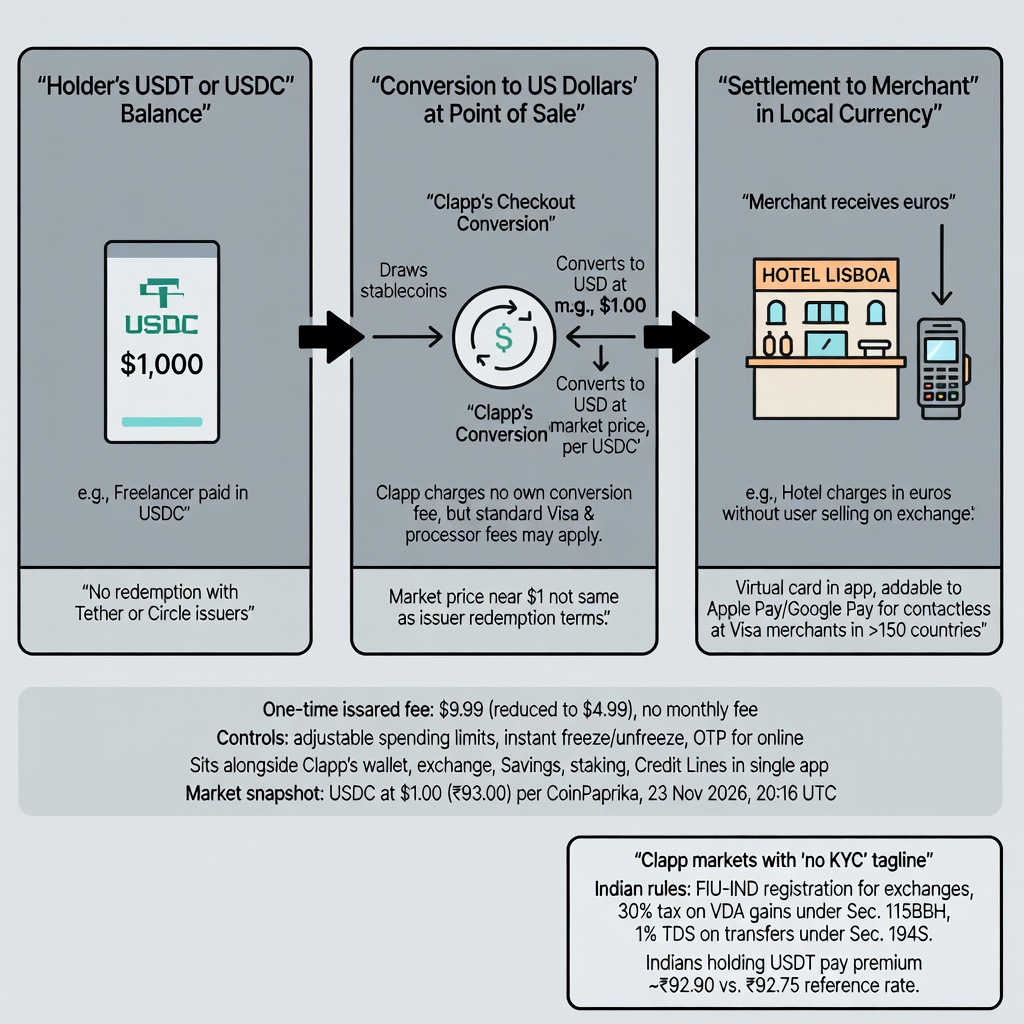
The product does not change how Tether or Circle issue or redeem their tokens. Clapp’s described path is a checkout conversion: the card takes stablecoins from the user’s balance, converts them to US dollars, and the merchant is paid in local currency. Holders are not described as redeeming with the stablecoin issuers. A market price near one dollar is not the same thing as those issuers’ redemption terms, and the launch does not say balances are insured or always redeemable.
What leaves the balance
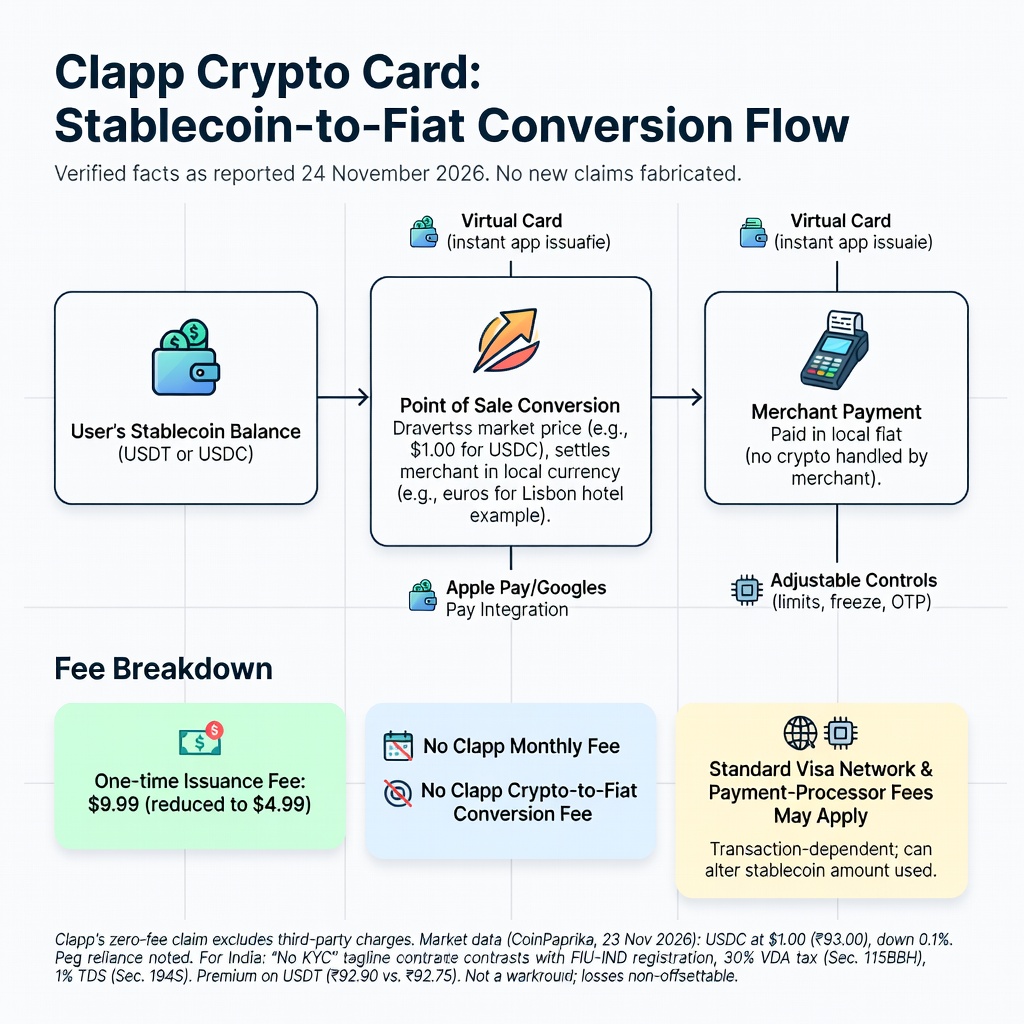
According to Crypto.news, the one-time issuance fee is $9.99, currently reduced to $4.99, and there is no monthly card fee. Clapp charges no fee of its own for the crypto-to-fiat conversion and no monthly card fee. That zero-fee claim stops at Clapp’s own charges. The company acknowledges that standard Visa network and payment-processor fees may still apply, depending on the transaction, so the stablecoin amount used on a given payment can differ from the merchant’s price once those third-party fees are included.
How a purchase is settled
Most supermarket checkouts and hotel desks cannot take a raw stablecoin balance. Clapp’s stated flow closes that gap at the moment of payment: USDT or USDC is drawn, converted to dollars, and the merchant is settled in local currency. The company’s example is a freelancer paid in USDC booking a hotel in Lisbon. The property charges in euros, the card uses the USDC balance, and the hotel receives euros without the user first selling coins on an exchange or topping up a separate account.
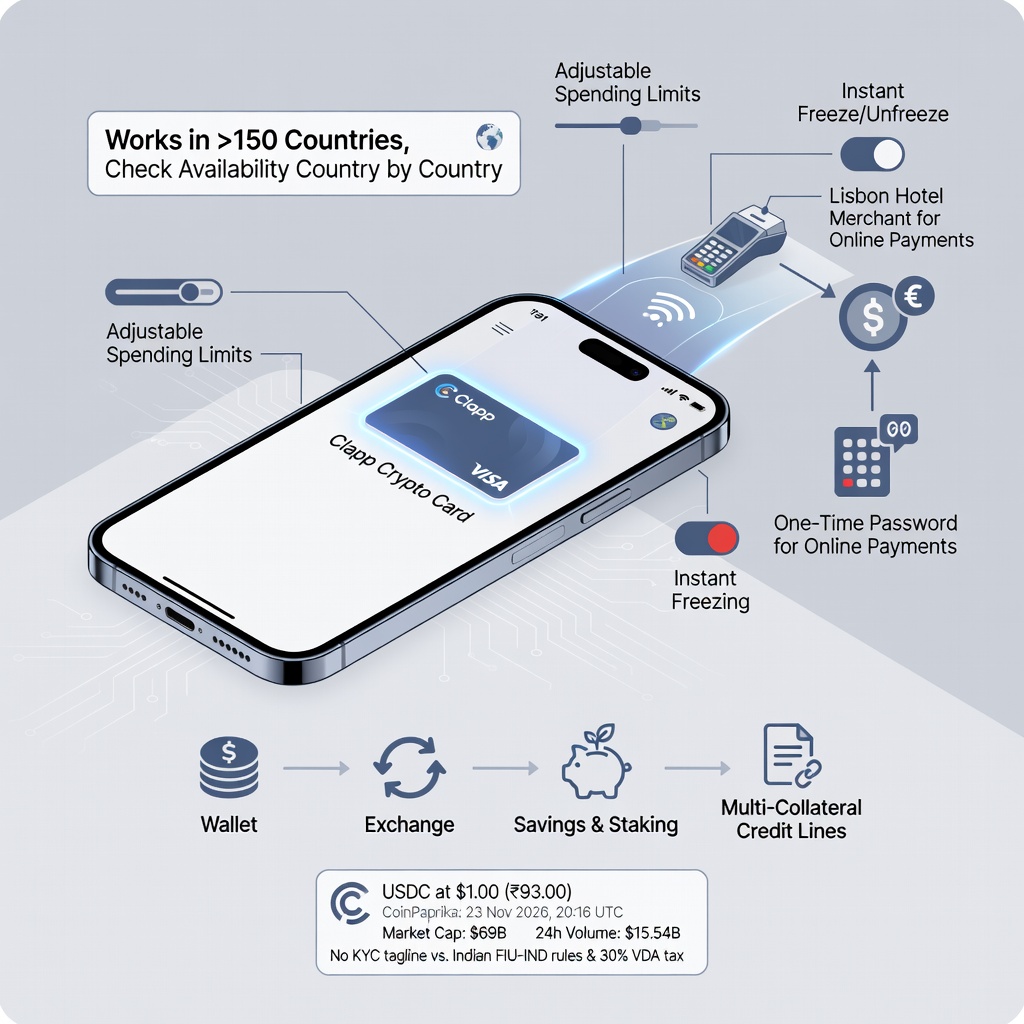
The card is a virtual product issued instantly in the app, so online purchases can start immediately. Clapp says it can be added to Apple Pay or Google Pay for contactless payments at Visa merchants, and that it works in more than 150 countries, online and in person. Coverage is not presented as uniform: Clapp advises users to check spending limits and availability country by country.
Controls described for the card are adjustable spending limits, an instant freeze and unfreeze, and a one-time password for online payments. A limit set just above an expected subscription charge is aimed at capping what a merchant can take if terms change.
In the same app, the card sits alongside Clapp’s wallet, exchange, Savings and staking, and multi-collateral Credit Lines. The report does not say the card itself is collateralised by those products.
Cited scale, not a forecast for this card
The report treats stablecoin cards as a concrete way digital dollars are spent beyond trading, because the merchant does not handle crypto; the card network and the issuer’s conversion sit behind the payment. It says Visa counted more than 160 such programmes by October 2026, and it cites a16z figures putting monthly crypto-card spending — mainly in USDT and USDC — at around $759 million in July, roughly 2.5 times the year-earlier level. Those are reported figures, not a projection of Clapp’s volume.
The report flags the next test as uptake outside Clapp’s existing users, and how the card’s effective cost compares with rival programmes once third-party fees are counted.
The dollar price the conversion relies on
CoinPaprika data timestamped 23 November 2026, 20:16 UTC, showed USDC at $1.00 (₹93.00), down 0.1% over 24 hours and 0.1% over seven days, with a market capitalisation of $69.00 billion and 24-hour volume of $15.54 billion. That is a traded price. It is not an attestation, not a full audit of reserves, and not a statement of redemption terms. The report notes that the card’s economics depend on that peg holding, because conversion happens at the point of sale.
A “no KYC” tagline next to Indian rules
Clapp markets the card with a “no KYC” tagline. The report sets that line against Indian rules: exchanges serving Indian users must register with FIU-IND as reporting entities, and gains on virtual digital assets are taxed at a flat 30% under Section 115BBH, with 1% tax deducted at source on transfers under Section 194S. Spending USDT through an offshore card is not described as a way around those obligations, and losses cannot be set off against other income.
On 23 November 2026, the report said Indians holding USDT already paid a small premium — about ₹92.90 per USDT against a ₹92.75 reference rate for the dollar — and that the effective cost of spending via a card needs to be weighed against that spread.