Index Industries is trying to turn a U.S. home-price index into a token that investors can hold, mint and redeem without owning a house. As reported on November 13, 2026, the product was still largely in its launch-preparation stage; its redemption and trading arrangements had yet to be tested through sustained operation.
The company announced a $50 million seed round on November 10, led by Lightspeed Venture Partners, with participation from Polychain Capital, Galaxy Ventures and Wintermute Ventures. It was co-founded by Josh Rosenthal, formerly president and general partner at Polychain Capital, and Brian Hardecker, founder and CEO of residential real-estate platform Longmark.

From a housing benchmark to a token
The market is large, but its size depends on the measure used. Federal Reserve financial accounts put the value of U.S. owner-occupied housing at $49.8 trillion and homeowners’ equity at about $35.8 trillion in the second quarter of 2026. Index Industries estimated the broader U.S. residential property market at $55 trillion.
The company’s USHP Index aims to produce a daily national home-price estimate. According to its description, the model draws on established measures including the FHFA Purchase-Only House Price Index and Freddie Mac House Price Index, then incorporates signals such as trends, momentum and mortgage affordability. Index Industries said the index had operated live since March 2026; earlier figures were backtested and hypothetical. It also said housing-data analytics firm Andrew Davidson & Co independently reviewed the index methodology. A methodology review is not an audit of the product’s reserves.

Index values and related pricing data are published to Ethereum through Chainlink oracles for use in the planned token’s issuance, minting and redemption. USHP, issued by USHP Limited, is designed to provide exposure to the index and be supported by housing-related reserve assets. It does not confer ownership of a home. A second product, USHPi, is designed to let holders convert USHP and potentially receive a distribution of some reserve-asset income from the USHP Foundation.

Reserves and the limits of redemption
A reserve snapshot disclosed on the USHP website for August 31, 2026, listed approximately 86% housing-related assets, 8% cash and cash equivalents, and 6% stablecoins and tokenized Treasury securities. Those figures describe the disclosed composition on that date, not cash available for every redemption.
Under the stated mechanism, minting and redemption are priced at the lower of the index price and the reserve net asset value per token. Consequently, a rise in the home-price index would not ensure redemption at the higher index-based valuation if reserve net asset value lagged. The pricing rule constrains valuation, but it cannot by itself make housing-related assets liquid.
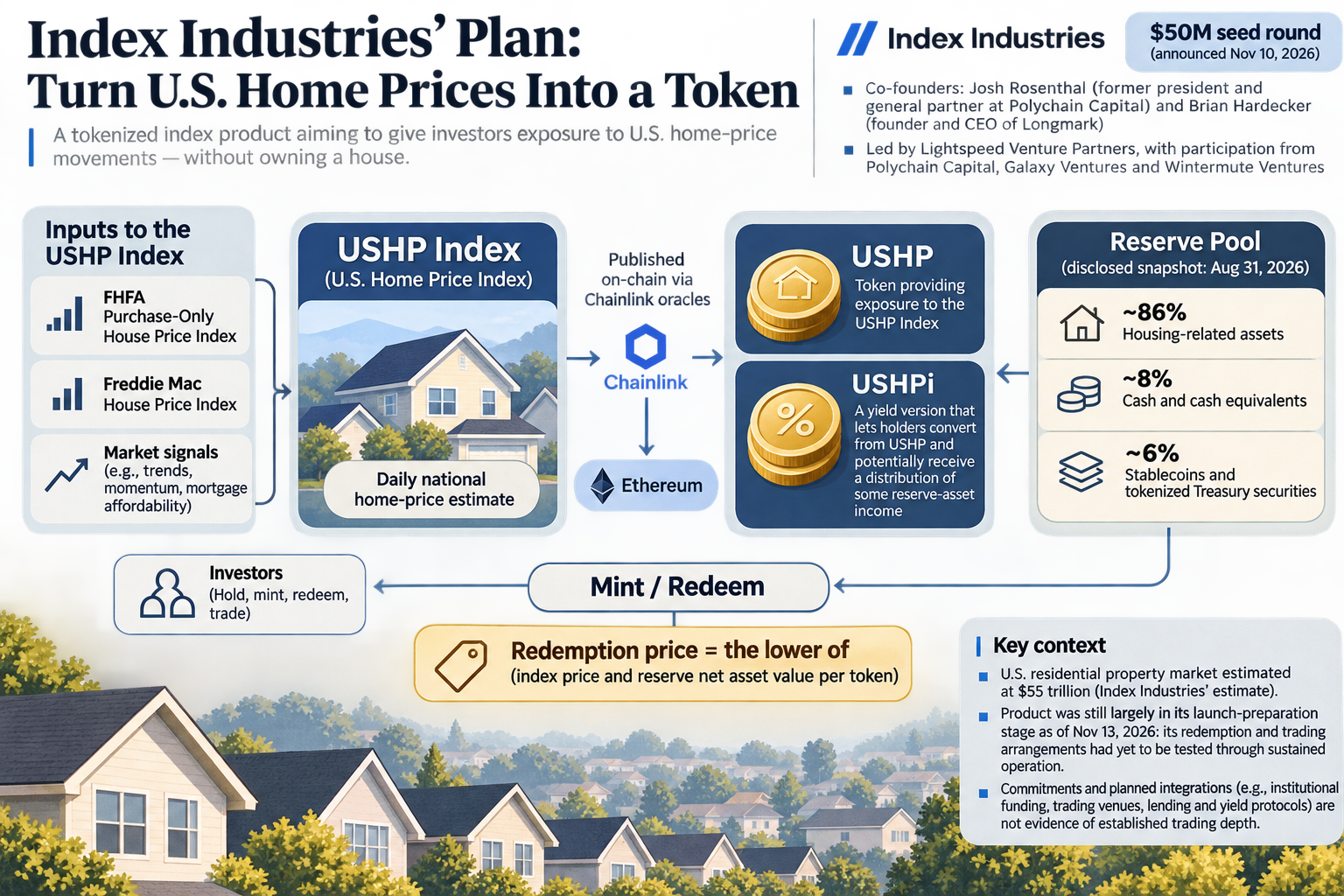
Index Industries reported up to $100 million in institutional funding commitments ahead of launch. Galaxy and its affiliates were expected to act as institutional minters and liquidity providers, while Forward Industries committed up to $50 million. The company also planned connections to lending markets, yield protocols and trading venues. Commitments and planned integrations are not evidence of established trading depth.
The challenge has a precedent. CME launched futures and options tied to S&P/Case-Shiller home-price indexes in May 2006, but its real-estate futures traded just 2,935 contracts in 2007, against 2.2 billion contracts across CME futures markets. In the first nine months of 2008, average real-estate futures volume fell 59% year over year and average open interest fell 70%. USHP’s reserve-backed token structure differs from those cash-settled derivatives, but whether it can sustain redemptions and two-way demand remains an open question.