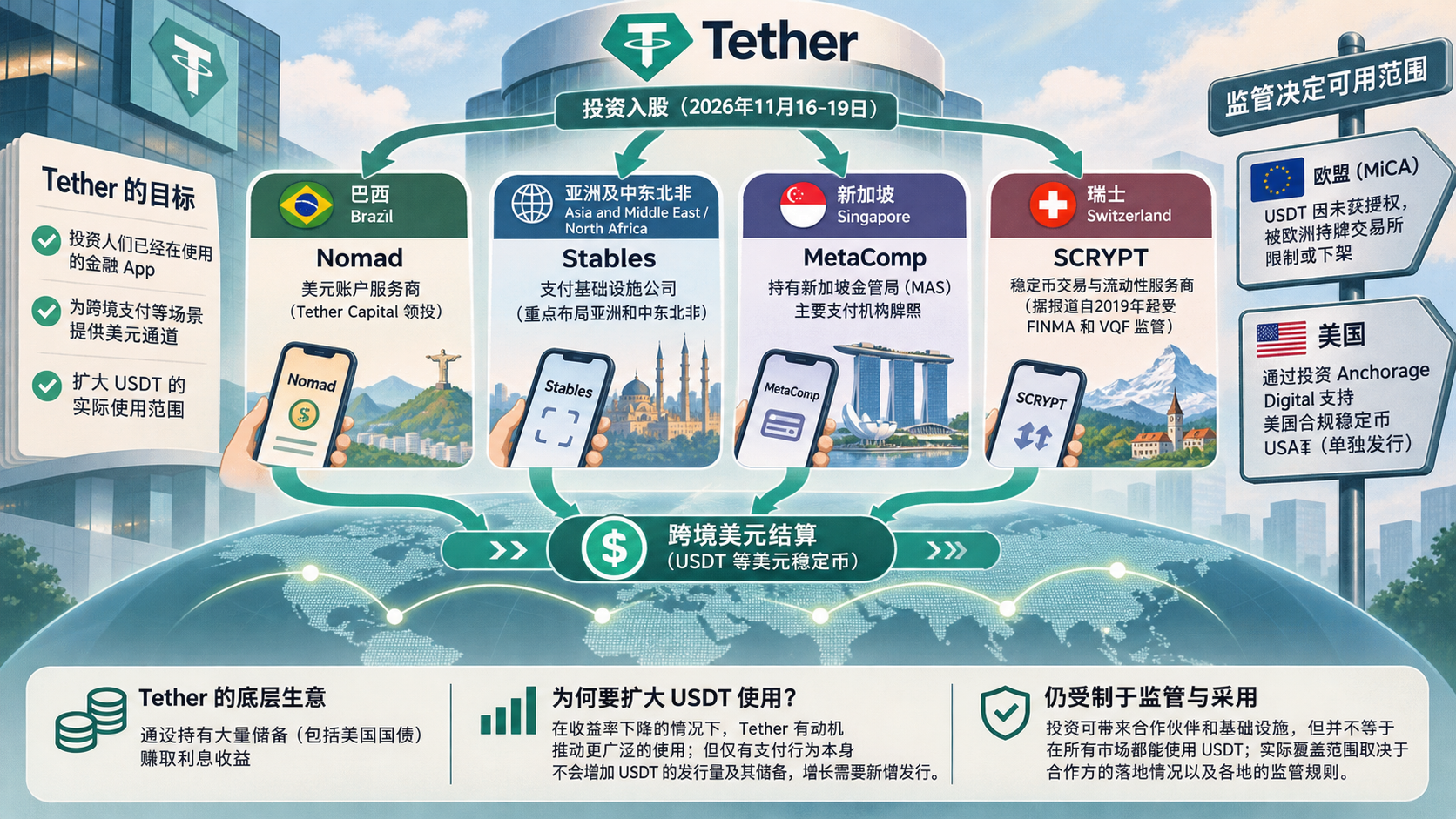
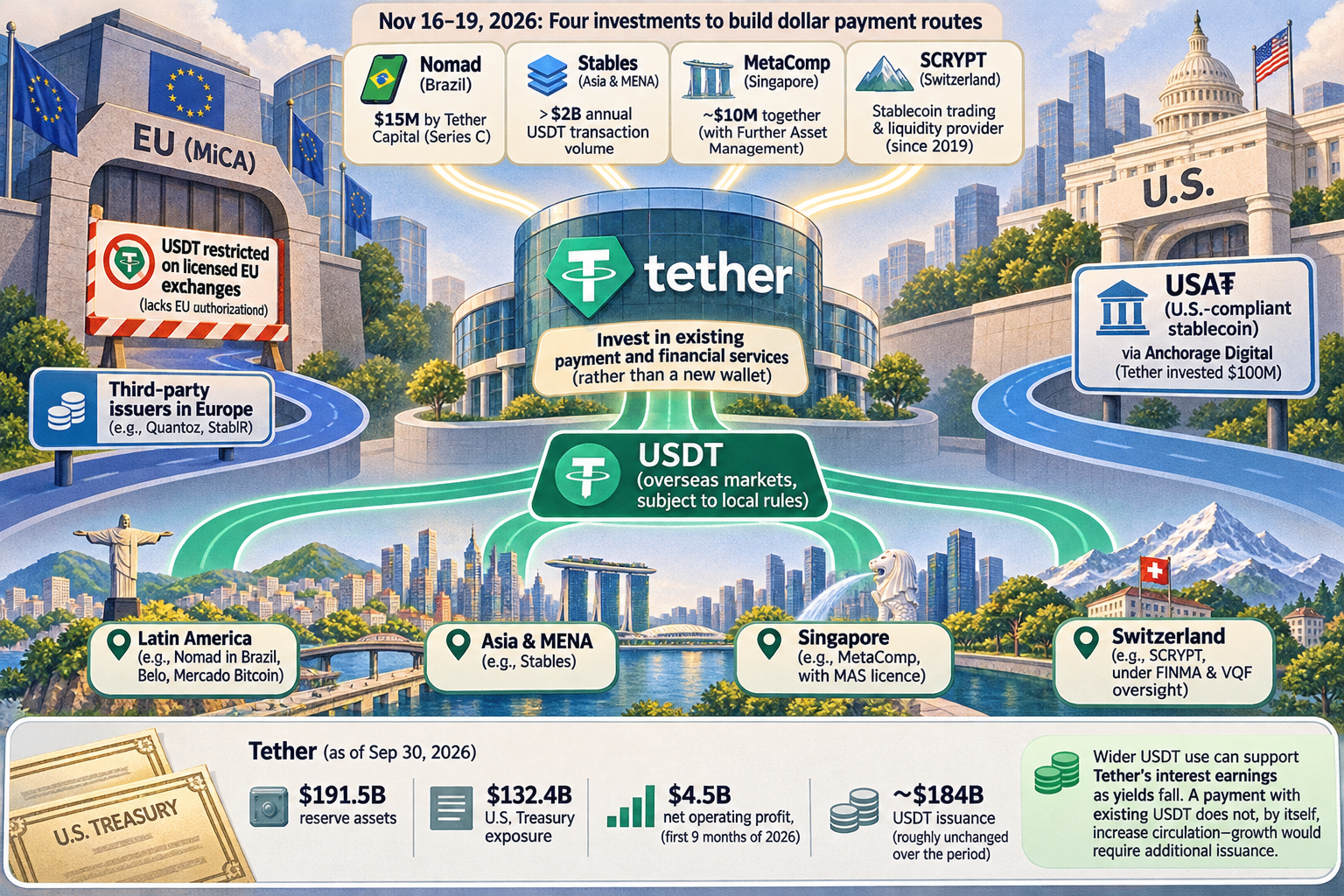
Between November 16 and 19, 2026, Tether backed four businesses that could help move dollars across borders. The investments covered a dollar-account provider in Brazil, a USDT payments company, a licensed payments firm in Singapore and a Swiss trading and liquidity provider. As reported on November 21, the deals pointed to a strategy: invest in services people and businesses already use, rather than require them to adopt a new wallet.
Four investments, different routes
Tether Capital led a $15 million investment in Brazilian dollar-account provider Nomad’s Series C round. The round totaled 172 million reais and valued Nomad at 4 billion reais after the investment. Nomad had 3.8 million customers and approximately 8 billion reais in assets under management. Support for USDT and Tether’s gold token, XAUT, was still being explored; no launch date had been announced.
Tether also invested in Stables, a payments infrastructure company processing more than $2 billion in annual USDT transaction volume and focused on Asia and the Middle East and North Africa. In Singapore, Tether and Abu Dhabi-based Further Asset Management invested approximately $10 million together in MetaComp, which holds a Major Payment Institution licence from the Monetary Authority of Singapore. In Switzerland, Tether backed SCRYPT, a stablecoin trading and liquidity provider that the original report said had operated under FINMA and VQF oversight since 2019. The report did not give investment amounts for Stables or SCRYPT.
Why circulation matters to Tether
Tether’s figures as of September 30, 2026, put reserve assets at $191.5 billion and U.S. Treasury exposure at $132.4 billion. It reported $4.5 billion in net operating profit for the first nine months of 2026, while USDT issuance had remained roughly around $184 billion over that period. The report contrasted that profit figure with more than $10 billion in net profit for the comparable period of 2025, but cautioned that the two measures use different definitions and cannot be directly subtracted.
Interest earned on reserves is important to Tether’s business. That gives the company a reason to seek wider USDT use as yields fall, though a payment made with existing USDT does not, by itself, increase the amount in circulation or the reserves backing it. Growth would require additional issuance.
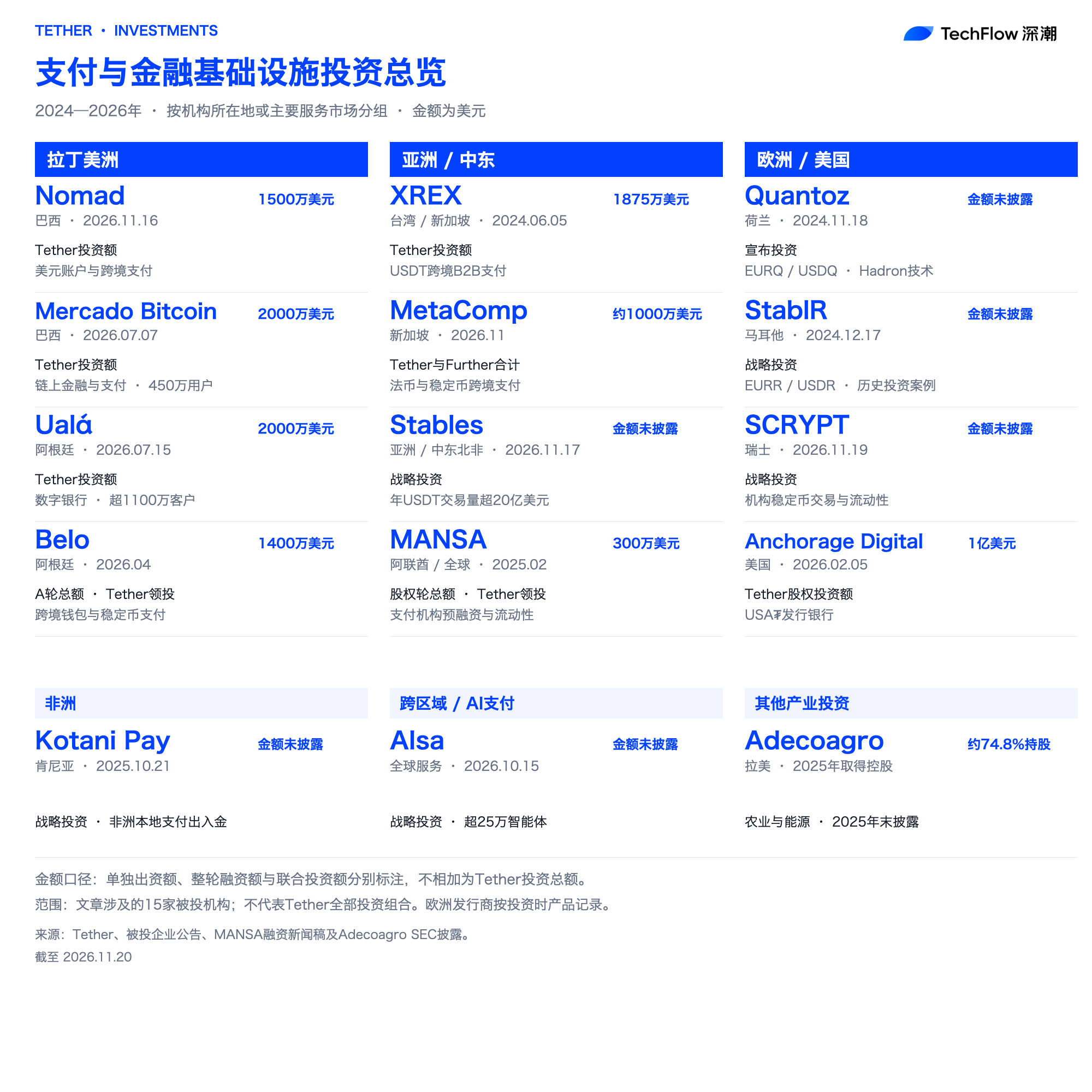
The November deals extend an investment pattern described in the report. In 2024, Tether invested $18.75 million in XREX for compliant cross-border business payments using USDT. It later backed payment or financial platforms including Kotani Pay in Kenya, Belo and Ualá in Argentina, and Mercado Bitcoin in Brazil. Investment does not mean token integration: the report said Ualá had not added USDT because of local regulatory limits.
Access still depends on regulation
Tether’s investments also differ by jurisdiction. After the EU’s MiCA stablecoin provisions began applying in 2024, licensed European exchanges restricted or removed USDT trading because it lacked EU authorization, according to the report. Tether instead backed European third-party issuers, including Quantoz and StablR. In the United States, it invested $100 million in Anchorage Digital, identified in the report as the issuer of USA₮, a separate U.S.-compliant stablecoin.
Those arrangements may provide Tether with partners and infrastructure, but they do not make USDT available wherever a partner operates. Nomad’s prospective integration remained undecided, Ualá had not integrated USDT, and European restrictions remained a constraint. The reach of any new payment route depends on both adoption and the rules governing it.