Published Nov. 28, 2026, at 04:50:15 UTC+08:00.
GraniteShares moved the effective date of the amendment covering its proposed 3x Long XRP Daily ETF and 3x Short XRP Daily ETF from Nov. 30 to Dec. 31, 2026. Its Nov. 27 filing with the U.S. Securities and Exchange Commission did not set a first trading date. Neither fund had begun trading, and the registration could still change.
The amendment also covers six proposed funds tied to Bitcoin, Ether and Solana. The underlying registration dates to an Oct. 7, 2025, amendment. GraniteShares said the sole purpose of its Oct. 26, 2026, filing, which had set the Nov. 30 date, was to delay the amendment.
What the daily target means
Before fees and expenses, the proposed long fund seeks three times XRP’s daily percentage change. The short fund seeks minus three times that change. According to its summary, the short fund would use cash-settled swaps, futures and options rather than hold XRP. U.S.-traded funds already targeting 2× daily XRP exposure include ProShares’ UXRP, Teucrium’s XXRP and Volatility Shares’ XRPT.
The daily reset matters when XRP reverses direction. Consider a hypothetical $1,000 position as XRP rises from $0.90 to $0.95 on the first day, then returns to $0.90 on the second. Each fund applies the second day’s return to its balance after the first day, not to the initial $1,000.
| Position | Day 1: XRP at $0.95 | Day 2: XRP back at $0.90 |
|---|---|---|
| Spot XRP | $1,055.56 | $1,000.00 |
| 3× daily long | $1,166.67 | $982.46 |
| 3× daily short | $833.33 | $964.91 |
In this illustration, both funds meet their daily targets exactly, before fees, financing costs and tracking differences. Yet the long position loses about 1.8% and the short position about 3.5%, while spot XRP finishes flat. These are hypothetical balances, not fund results. The SEC’s investor bulletin on leveraged and inverse ETFs warns that returns over more than one day can differ sharply from the stated multiple. Repeated reversals can widen the gap; a sustained move can instead compound gains for the fund positioned in that direction.

XRP’s range ahead of the Nov. 30 weekly close
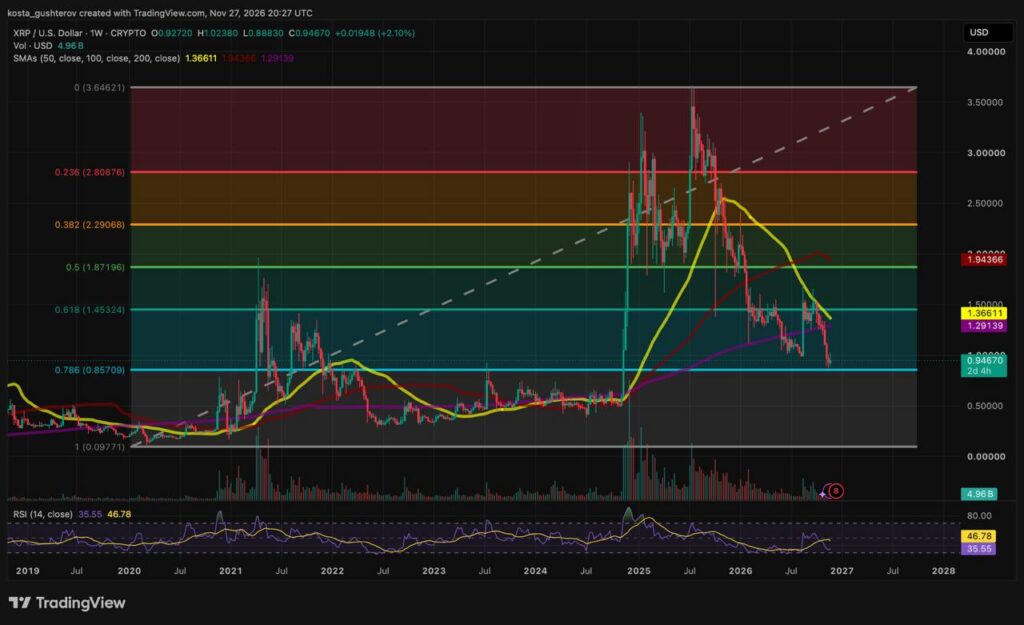
The hypothetical round trip was smaller than XRP’s actual weekly swing. On the Nov. 27 TradingView XRP/USD chart, XRP was near $0.95 after opening the week around $0.93. A Monday rise to $1.02 reversed within the session, and XRP later traded as low as $0.89. With two days left in the weekly candle, XRP was up roughly 2%, about 6.6% above the low and 7.5% below the high. Turnover was approximately $4.96 billion. A Nov. 25 analysis had identified buying near $0.86 and stalled rebounds near $1.02.
Weekly relative strength index (RSI) stood at 35.55, below its 46.78 average. It had spent much of the first half of 2026 near 30 as XRP continued to fall. After breaking out of a multiyear $0.30–$0.75 range in late 2024, XRP reached two major peaks in 2025. The second, at $3.65, came on lighter volume and with a lower weekly RSI than the first. Subsequent highs were lower.
XRP lost the 50% retracement near $1.87 early in 2026 and spent much of the year between the 61.8% retracement near $1.45 and the rising 200-week moving average. It slipped below that average around midyear, regained it in August and then stalled near the falling 50-week average. November’s decline left XRP roughly 27% below the 200-week average of $1.29. The 50-week average, at $1.37, had crossed below the 100-week average around midyear. The 100-week average, at $1.94, had also begun to decline.
The chart analysis set out three conditional readings for the weekly close at 00:00 UTC on Nov. 30, not price forecasts:
- If $0.86 held but XRP remained capped near $1.29: A rebound toward $1.15–$1.30 would test the 200-week average from below. A reversal there would be consistent with a roughly $0.70–$1.25 range when intraweek swings were included.
- If XRP closed below $0.86 on heavier volume: The next reference was the former range ceiling near $0.75, followed by the $0.55–$0.70 base formed in 2024, when XRP spent much of the year around $0.50–$0.65.
- If XRP closed above $1.29: Regaining the 200-week average would weaken the bearish reading. A move above $1.37 and $1.45, with weekly RSI back above 50, would bring $1.87–$1.94 and the 38.2% retracement near $2.29 into view.
XRP had already lost and regained the 200-week average before falling below it again. A single weekly close had not established a lasting direction. For the proposed ETFs, the distinction is narrower: their targets apply to each day’s move, not to XRP’s change between weekly closes.